
When people hear “55+ community in Florida,” they sometimes picture one very specific lifestyle: expensive homes, golf courses, country clubs and large monthly association fees.
That is only one part of the picture.
Southwest Florida offers 55+ living in many different forms — from modest manufactured-home communities and smaller condominiums to villas, single-family homes, golf communities and upscale resort-style developments.
The better question isn't “Can I afford a 55+ community?”
It is:“What kind of 55+ lifestyle fits me?”
And the answer may be very different for every buyer.
A 55+ community is generally designed and operated as housing for older adults under the federal Housing for Older Persons Act, commonly called HOPA.
For a community to qualify under the federal 55+ exemption, at least 80% of its occupied units generally must have at least one resident who is 55 or older, and the community must maintain policies and age-verification procedures showing that it intends to operate as housing for older persons.
That does not automatically mean nobody under 55 can ever live there or that grandchildren can't visit.
Each community can have its own occupancy, guest and age rules.
That's one reason buyers should read the actual community documents rather than assuming every 55+ neighborhood operates the same way.
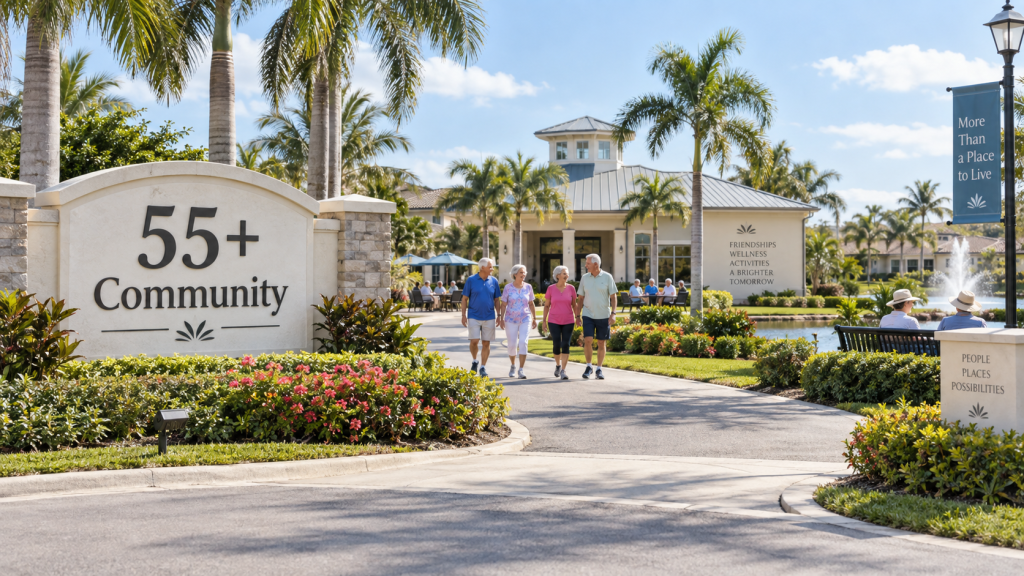
One of the biggest advantages of Southwest Florida is the variety.
You may find:
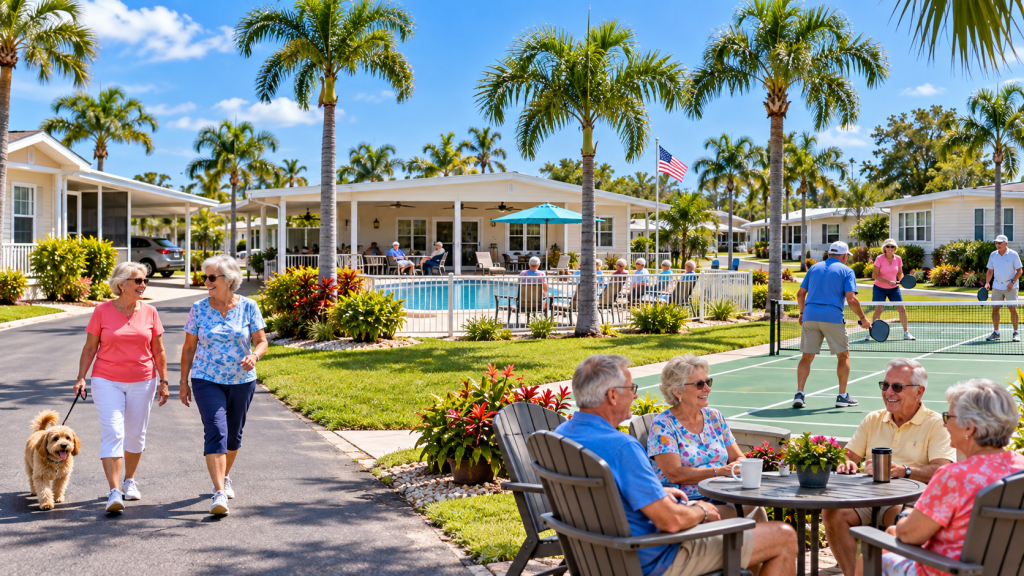
Manufactured or mobile homes. These can provide one of the most economical ways to enjoy Florida retirement living. Some communities have pools, clubhouses, shuffleboard, activities and social clubs without the purchase price of a traditional house.
Condominiums. Condos can appeal to people who want less exterior maintenance, particularly seasonal residents who may leave Florida for several months each year.
Villas and attached homes. These can offer the feel of a small house while the association takes care of some exterior maintenance and landscaping.
Single-family homes. Many active-adult communities offer traditional homes ranging from relatively modest residences to large custom homes.
Golf, waterfront and resort communities. At the upper end are communities with championship golf, marinas, restaurants, fitness centers, elaborate pools and extensive social programs.
There is no reason to assume that one is automatically better than another.
The right home is the one that fits your finances and the way you actually want to live.

This part often gets overlooked in Florida real-estate advertising.
Not everyone retiring to Florida wants — or can afford — a $500,000 home accompanied by a large HOA bill.
And they shouldn't be ignored.
Southwest Florida has manufactured-home and mobile-home communities where the initial cost of the home may be considerably less than a conventional single-family property.
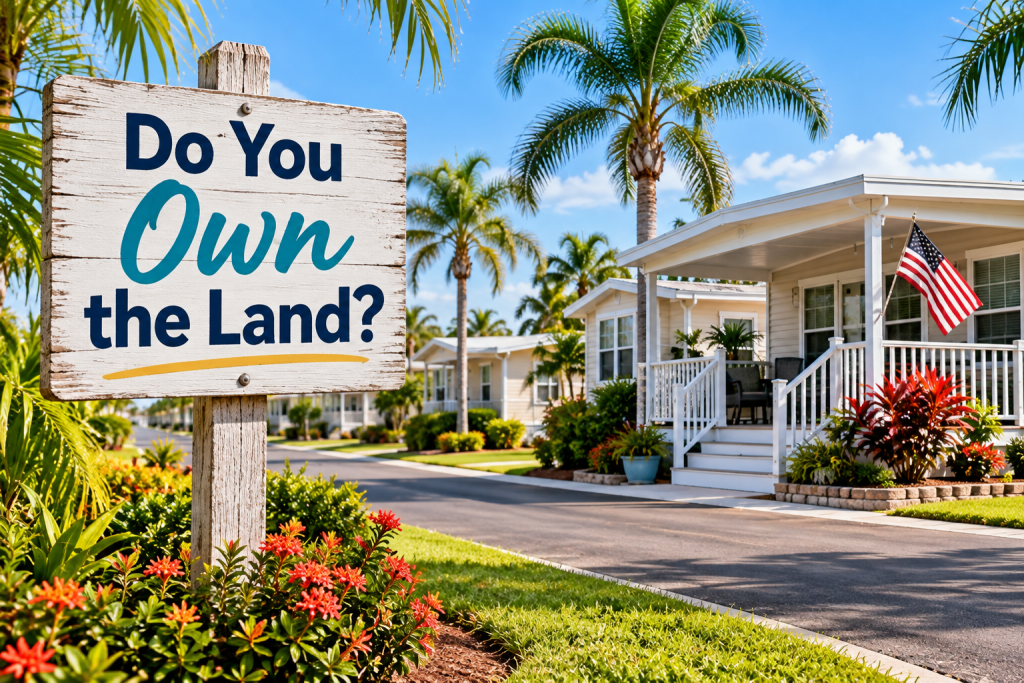
But there is an important question:
This can make an enormous difference.
In some manufactured-home communities, you purchase the home but rent the land underneath it.
In others, residents own the land or have some form of cooperative ownership.
A low purchase price can look very attractive until you discover that substantial monthly lot rent must also be paid.
Florida has specific laws governing many mobile-home park lot tenancies. Chapter 723 of the Florida Statutes applies in many situations where the homeowner owns the mobile home but rents a lot in a park containing 10 or more rental lots.
Florida law also establishes procedures involving park rules, fees and lot-rent increases. For example, affected homeowners generally must receive at least 90 days' written notice before certain lot-rent increases, reductions in services or changes in park rules.
So when comparing manufactured-home communities, don't ask only:
How much is the home?”**
Ask:
“How much will it cost me to live here every month?”
That is the number that matters.
This same rule applies to every kind of 55+ community.
Imagine two homes.
One costs $225,000.
The other costs $285,000.
At first glance, the $225,000 home appears to be the obvious bargain.
But what if the first property has $900 a month in combined community costs while the second costs $300?
Suddenly theBefore deciding what you can afford, look at the entire cost of ownership: comparison looks very different.
HOA, condominium or community fees
Lot rent, if applicable
Property taxes
Homeowners insurance
Flood insurance when needed
Special assessments
Community or recreational fees
Golf or club memberships
Utilities
Maintenance
Landscaping
Future increases in association or lot costs
Affordable housing is not necessarily the property with the lowest asking price.
t's the property whose total cost fits comfortably into your life.

An HOA fee isn't automatically good or bad.
The question is what you're receiving for the money.
A community fee might include landscaping, lawn maintenance, cable or internet, exterior maintenance, security, recreational facilities or other services that you would otherwise pay for separately.
Another community might charge a similar amounSome people genuinely want:t while providing very little.
Some people genuinely want:
Resort-style swimming pools
Pickleball and tennis
Fitness centers
Golf
Restaurants
Organized trips
Clubs and classes
Social events
Walking and biking trails
Others would happily trade all of that for a smaller monthly bill and a quiet neighborhood
Neither person is wrong.

One reason 55+ communities remain popular is that they can make meeting people much easier.
Moving to a new state after retirement can mean leaving behind neighbors, coworkers, friends and organizations you've known for decades.
An active-adult community can provide an instant social network.
There may be card nights, exercise groups, fishing clubs, pickleball leagues, dances, dinners, travel clubs, volunteer groups and dozens of other activities.
But don't pay for a lifestyle you aren't going to use.
f you don't play golf, don't care about a clubhouse and would rather spend your afternoon fishing, boating or sitting on the beach, an expensive amenity package may make little sense.

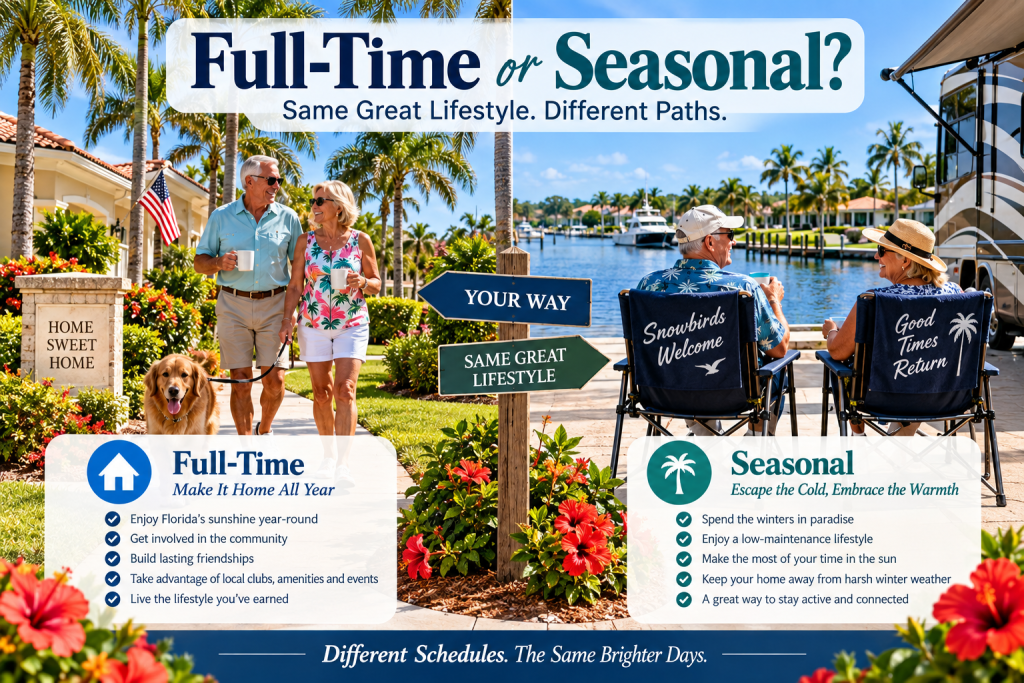
You also don't necessarily have to move to Florida permanently.
Some people make Southwest Florida their full-time home.
Others keep their northern home and spend the winter here.
For seasonal residents, different features become important.
A condominium or low-maintenance community may be attractive because there is less to worry about while you're away.
Someone moving permanently may want additional storage, a garage, workshop space, a larger home or a neighborhood where most residents stay throughout the year.
Again, there is no universal right answer.
At 60 or 65, driving 30 minutes to the grocery store may not bother you.
At 80, it might.
When evaluating a retirement community, consider more than today's lifestyle.
Look at proximity to:
Doctors
Hospitals
Pharmacies
Grocery stores
Restaurants
Family
Airports
Beaches
Recreation
Also consider whether the home itself would remain comfortable if stairs or extensive yard maintenance become more difficult later.
A good retirement home should work for today's life while giving you options for tomorrow.

This is particularly important in 55+ communities.
Rules may address:
Pets
Fences
Parking
Pickup trucks
Motorcycles
Boats and RVs
Renting your home
How long guests may stay
Younger family members
Exterior changes
Landscaping
Home businesses
Manufactured-home parks can have detailed rules as well. Florida law specifically addresses park rules and regulations, and guests and family members are generally expected to comply with properly adopted park rules
A beautiful home isn't a bargain if the community rules prevent you from living the way you want.
After helping people buy and sell homes for decades, I've learned that the most expensive home isn't necessarily the home that makes someone happiest.
Retirement should give you more choices, not fewer.
Maybe you want golf, boating and a beautiful clubhouse. Maybe you want a comfortable manufactured home, friendly neighbors and enough money left over to travel. Maybe you want to live here year-round. Maybe Southwest Florida is simply where you want to spend the winter.
My job is not to tell you which lifestyle you should choose.
It's to help you understand the choices, the costs and the communities so you can decide which one feels like home.
— Johnny Joyce