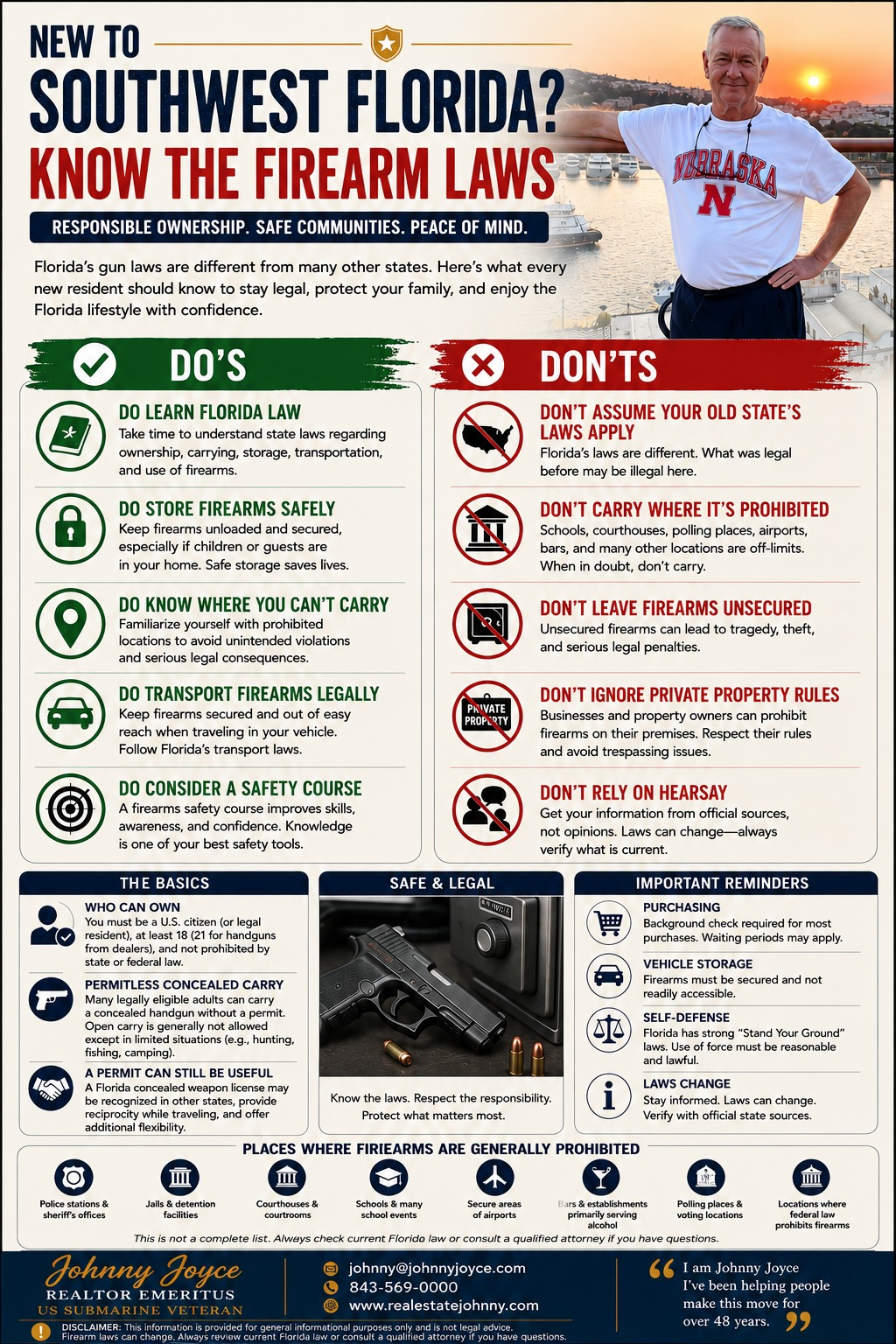
Florida Firearm Laws: What Southwest Florida Residents Should Know
Updated August 2026
Florida firearm laws apply throughout Southwest Florida, including Fort Myers, Cape Coral, Naples, Bonita Springs, Estero and surrounding communities in Lee, Collier, Charlotte and Hendry counties. Most firearm ownership, possession, carrying and transportation rules are established at the state level rather than by individual cities or counties. Nevertheless, property restrictions, local firearm-discharge ordinances and federal laws can affect what is permitted in a particular location.
This article provides a general, nonpolitical overview of Florida gun laws. It is educational information—not individualized legal advice. Because firearm laws and court decisions can change, readers should verify current requirements before purchasing, carrying or transporting a firearm.
Who May Own or Possess a Firearm in Florida?
Florida does not require a general state permit to own or purchase a firearm. However, state and federal laws prohibit certain individuals from possessing firearms or ammunition. These restrictions can apply to convicted felons, people subject to qualifying domestic-violence or stalking injunctions, individuals convicted of certain domestic-violence offenses, and people prohibited under applicable mental-health or federal laws.Florida also authorizes courts to issue risk protection orders. A qualifying order can temporarily prohibit a person from purchasing, possessing or receiving firearms and ammunition and may require the surrender of firearms already in that person’s possession. Florida’s risk protection order process is described in Section 790.401 of the Florida Statutes.Anyone uncertain about whether a past conviction, injunction, court order or mental-health proceeding affects firearm eligibility should consult a qualified Florida attorney before possessing or attempting to purchase a firearm.
Purchasing a Firearm in Florida
Florida generally imposes a waiting period of three days, excluding weekends and legal holidays, or until the required background check is completed—whichever occurs later. Certain exceptions apply, including purchases by holders of a valid Florida concealed weapon or firearm license, qualifying trade-ins and some rifle or shotgun purchases involving eligible hunter-safety credentials. Counties may impose a waiting period of up to five days in circumstances authorized by the Florida Constitution and state law. Current purchasing requirements are summarized by the Florida Department of Law Enforcement and in Section 790.0655 of the Florida Statutes.
A person must provide accurate information during the purchase process. Attempting to buy a firearm while legally prohibited—or providing false information during a background check—can lead to serious state and federal charges.
Concealed Carry in Florida
Florida allows an eligible person to carry a concealed handgun without obtaining a concealed weapon or firearm license. This is commonly called permitless concealed carry. It does not mean that anyone may carry a firearm anywhere.
A person carrying without a license must meet the same basic eligibility standards required for a Florida concealed carry license. The person must generally be at least 21 years old, be legally permitted to possess a firearm and carry valid identification. The identification must be displayed upon lawful demand by a law-enforcement officer. Unlicensed concealed carriers are also subject to the same prohibited-place restrictions that apply to licensed carriers. These requirements appear in Section 790.013 of the Florida Statutes.
lorida continues to issue concealed weapon or firearm licenses. A license can still be useful for interstate reciprocity, firearm-purchase waiting-period exemptions and documenting that the holder completed the application and training requirements. Travelers must research the law of every other state they enter because Florida’s permOpen Carry in Floridaitless-carry rules end at the state line.
Open Carry in Florida
Florida’s open-carry rules changed significantly in 2025. In McDaniels v. State, Florida’s First District Court of Appeal held that the state’s general ban on openly carrying firearms was unconstitutional as applied to law-abiding adult citizens. The Florida Attorney General subsequently advised law-enforcement agencies and prosecutors that they should not arrest or prosecute a law-abiding adult solely for openly carrying a firearm in public. The official guidance is available from the Florida Attorney General’s Office.
That decision did not eliminate every restriction involving firearms. Prohibited-person laws, prohibited-place rules, private-property rights and laws against threatening, careless or improper firearm use remain applicable. Because the statutory text and the court decision must be read together, anyone planning to openly carry should review the latest legal guidance and consider consulting a Florida attorney.
Places Permitless carry and a concealed carry license do not authorize firearm possession everywhere. Florida law restricts concealed firearms in locations that include:Where Firearms Remain Prohibited
olice, sheriff and highway-patrol stations
Jails, prisons and detention facilities
Courthouses and courtrooms
Polling places
Meetings of specified governmental bodies
Elementary and secondary school facilities
Career centersCollege and university facilities, subject to narrow exceptions
School, college or professional athletic events not related to firearms
The portion of an establishment primarily devoted to serving alcohol for consumption on-site
Airport passenger terminals and sterile areas, except for properly encased firearms being checked for lawful air travel
Locations where firearms are prohibited by federal law
The complete list and its exceptions appear in Section 790.06 of the Florida Statutes.
Federal restrictions may also apply at federal courthouses, post offices, secured airport areas and certain other federal properties. Schools and school-sponsored events are subject to additional restrictions under Florida law.
Private-property owners may control access to their homes and businesses. A person who refuses to leave after being directed to do so may face a trespass allegation, regardless of whether carrying the firearm would otherwise be lawful.
Firearms in Vehicles
A person who is legally permitted to possess a firearm may generally keep a handgun inside a private vehicle if it is securely encased or otherwise not readily accessible for immediate use. Examples of secure encasement can include a closed glove compartment, closed console, gun case or closed container.
A person legally authorized to carry a concealed firearm may carry it on or about the person while inside a vehicle. Florida also provides certain protections concerning lawfully possessed firearms kept in private vehicles in parking areas, although exceptions apply to particular workplaces and properties. Vehicle possession rules are addressed in Sections 790.25 and 790.251.
From a safety standpoint, an unattended firearm should be secured in a locked container attached to the vehicle and kept out of sight. A locked vehicle alone is not an ideal substitute for a dedicated firearm safe.
Safe Storage Around Children
Florida law requires secure storage when a person leaves a loaded firearm on premises under that person’s control and knows—or reasonably should know—that a minor is likely to gain access without lawful permission or supervision. The firearm generally must be secured in a locked box or container, placed in a location reasonably believed to be secure, or fitted with a trigger lock. An exception applies when the firearm is carried on the person or kept close enough for immediate retrieval and use.
The statute defines a minor for this specific safe-storage provision as someone younger than 16. Violations can result in criminal penalties when a minor gains unauthorized access and possesses or exhibits the firearm in a prohibited manner. The requirements are contained in Section 790.174 From a safety standpoint, an unattended firearm should be secured in a locked container attached to the vehicle and kept out of sight. A locked vehicle alone is not an ideal substitute for a dedicated firearm safe.of the Florida Statutes.
Self-Defense and the Use of Force
Owning or carrying a firearm does not automatically justify displaying, threatening or using it. Florida law distinguishes between nondeadly force and deadly force.
Deadly force may generally be used only when a person reasonably believes it is necessary to prevent imminent death, great bodily harm or the imminent commission of a forcible felony. Florida law can remove the duty to retreat when a person is not engaged in criminal activity and is in a place where that person has a legal right to be. However, every self-defense incident depends heavily on its specific facts.
“Stand your ground” is not permission to escalate arguments, threaten someone over a minor dispute or use deadly force solely to protect ordinary property. Brandishing or displaying a firearm in an angry, careless or threatening manner can create serious criminal exposure unless the conduct is legally justified. Florida’s principal self-defense provisions are collected in Chapter 776 of the Florida Statutes.
Are There Special Southwest Florida Gun Laws?
Florida broadly preempts local regulation of firearm ownership, possession, storage, purchase and transportation. This creates substantial statewide uniformity across Fort Myers, Cape Coral, Naples, Bonita Springs, Estero and neighboring communities. The preemption law appears in Section 790.33 of the Florida Statutes.
That does not mean location never matters. Counties may exercise limited authority where state law expressly allows it, including certain firearm-purchase waiting periods and firearm-discharge regulations. Local restrictions may affect target shooting or firearm discharge in populated or residential areas. Rules can also differ on school property, government property, preserves, parks, airports, private communities and federally managed land.
Before discharging a firearm anywhere in Southwest Florida, confirm that the activity is legal for that exact parcel and that a safe backstop and sufficient distance from homes, roads and occupied structures are available. The legality of possessing a firearm is separate from the legality of firing it.
Practical Guidance for Florida Gun Owners
Responsible firearm ownership in Southwest Florida begins with knowing both the law and the firearm itself. Owners should consider professional safety training even when training is not legally required. Firearms should be securely stored, handled only by authorized people and transported in compliance with state and federal law.
Before carrying a firearm, verify that you are legally eligible, understand prohibited locations, carry valid identification and know the difference between possession, display and lawful defensive use. When traveling outside Florida, research the destination’s firearm laws and every state crossed along the way.
For the most current statewide information, consult Chapter 790 of the Florida Statutes. Questions involving criminal history, court orders, interstate travel, self-defense incidents or eligibility to possess a firearm should be directed to a qualified attorney.