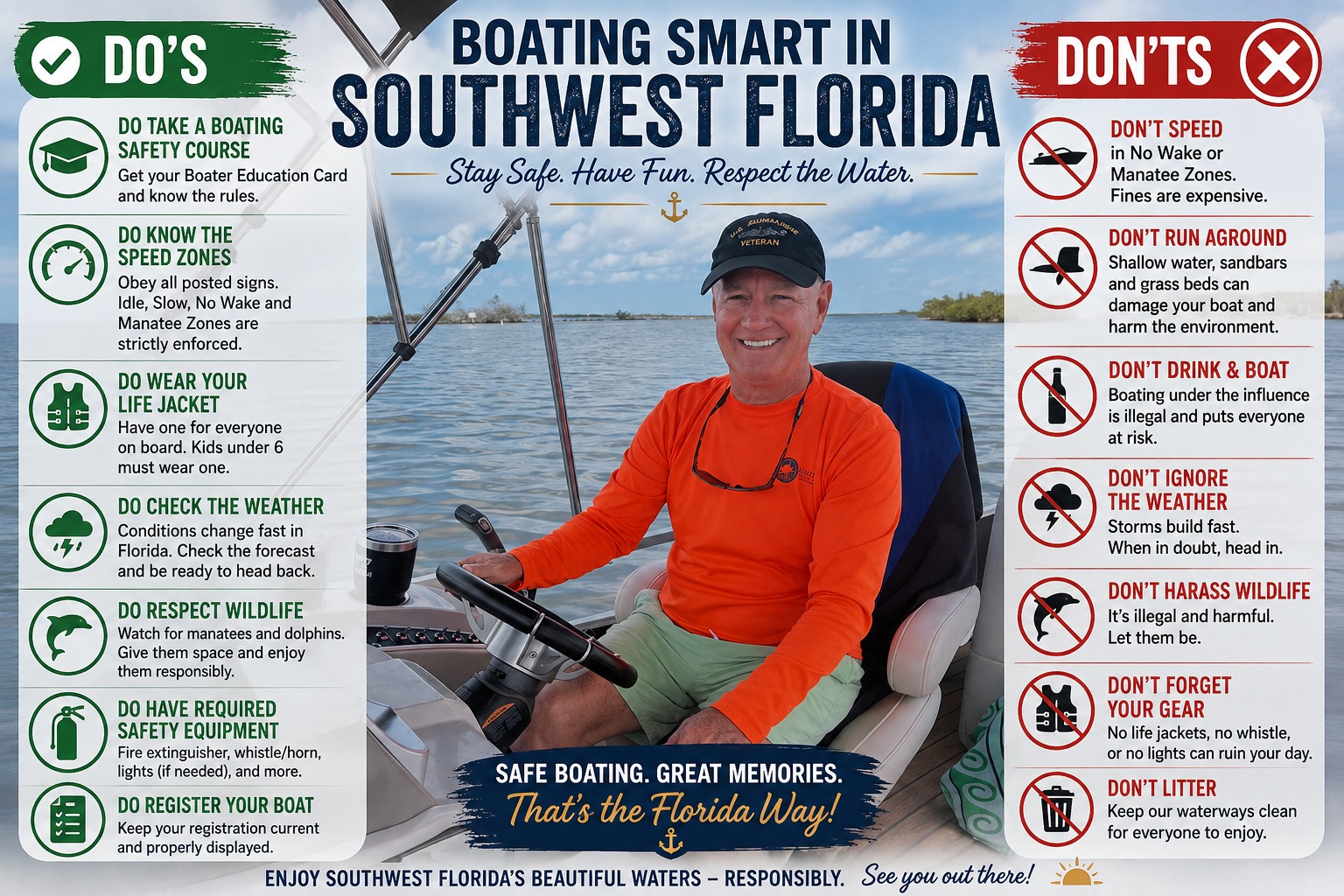
Boating in Southwest Florida offers an unforgettable way to explore the Gulf waters, Intracoastal Waterway, Caloosahatchee River, Charlotte Harbor, Pine Island Sound, Matlacha Pass, Naples Bay, Estero Bay, Sanibel Island, Captiva Island, Fort Myers Beach and the Ten Thousand Islands. Whether you own a boat, rent a center-console for the day, operate a personal watercraft or are considering waterfront living in Southwest Florida, understanding Florida boating laws is essential. Shallow water, shifting sandbars, narrow channels, afternoon thunderstorms, strong tidal currents and protected wildlife habitats make local knowledge just as important as knowing how to operate the vessel.
Florida does not issue a traditional “boating license,” but anyone born on or after January 1, 1988, generally must complete an approved boating-safety course and carry a Florida Boating Safety Education Identification Card, along with photo identification, when operating a motorboat of 10 horsepower or greater. Nonresidents may use an approved out-of-state or NASBLA-recognized certificate, while qualified renters can obtain a temporary certificate. Boat operators should verify their particular eligibility before leaving the dock. The Florida Fish and Wildlife Conservation Commission boating regulations provide the state’s central source for current requirements.
Every recreational vessel must carry a readily accessible, properly sized and serviceable U.S. Coast Guard-approved life jacket for each person aboard. Boats measuring 16 feet or longer generally must also carry an immediately available throwable flotation device. Children younger than six must wear an approved life jacket while underway on a vessel measuring less than 26 feet. Depending on the boat’s size, design and operating area, additional required boating-safety equipment may include a fire extinguisher, sound-producing device, navigation lights, ventilation system, backfire flame arrestor and visual distress signals. Boats operating after sunset or during restricted visibility must display the proper navigation lights. Owners should consult the FWC’s required boating-safety equipment guide because the precise requirements depend on vessel length and where the vessel is operated.
Florida boating laws require vessels to be operated at a safe speed and in accordance with navigation rules. Operators must maintain a proper lookout, consider visibility, traffic, water depth, weather and stopping distance, and take reasonable action to avoid collisions. “Idle Speed—No Wake,” “Slow Speed—Minimum Wake” and other posted boating-restriction signs are enforceable speed limits, not suggestions. Careless operation can produce a citation, while reckless operation—operating with willful or wanton disregard for people or property—is a criminal offense. Extra caution is necessary around swimmers, paddlers, docks, marinas, anchored vessels, divers, congested channels and waterfront homes.
Southwest Florida contains extensive manatee-protection and boating-restricted zones, particularly in Lee, Charlotte and Collier counties. Boaters must obey all posted seasonal and year-round speed zones, even when a chart or navigation application shows something different. Manatees are protected by state and federal law, and intentionally disturbing, feeding, chasing, touching, injuring or harassing them is prohibited. Operators should wear polarized sunglasses, designate a wildlife lookout and reduce speed in shallow or murky water. Current county maps are available through the FWC’s manatee-protection-zone map center. Any collision with a manatee should be reported immediately to the FWC Wildlife Alert Hotline, even when the animal swims away.
Boating under the influence is illegal throughout Florida. A person commits BUI when operating a vessel while normal faculties are impaired or with a blood- or breath-alcohol level of 0.08 or higher. Passengers of legal drinking age may generally possess alcohol, but the operator must remain sober and capable of safely controlling the boat. Florida’s implied-consent provisions apply to vessel operators, and refusing a lawful chemical test can result in penalties. Sun, heat, dehydration, engine noise and constant movement can intensify alcohol’s effects, making a sober designated operator especially important. Complete information appears in Florida Statute §327.35.
Most motorized vessels principally operated in Florida must have a valid registration, carry the registration certificate aboard and properly display registration numbers and a current decal. Federally documented recreational vessels operating in Florida waters may also require Florida registration and a state validation decal. Owners should confirm title, registration, tax and documentation requirements with the Florida Department of Highway Safety and Motor Vehicles or the appropriate county tax collector. Rental operators must provide the required safety instruction, but the person at the helm remains responsible for lawful and careful operation.
Personal watercraft such as Jet Skis and WaveRunners are subject to additional restrictions. Operators must generally be at least 14 years old, and a person must be at least 18 to rent one. Everyone riding a personal watercraft must wear an approved life jacket, and the operator must properly use the engine cutoff switch when the machine is equipped with one. Personal watercraft may not be operated from one-half hour after sunset until one-half hour before sunrise, even when navigation lights have been installed. Reckless maneuvers, including weaving through congested traffic, jumping another vessel’s wake dangerously close to that vessel or forcing others to take evasive action, are prohibited.
Anglers must carry the appropriate Florida saltwater or freshwater fishing license unless an exemption applies. Seasons, size limits, bag limits, closed areas and required equipment vary by species and may change during the year. Gulf federal-water regulations may differ from Florida state-water regulations, so boaters fishing offshore must know where state waters end and federal waters begin. Regulations should be checked before every trip using the current FWC fishing rules rather than relying on an old photograph, brochure or previous season’s information. Seagrass beds, oyster reefs, mangrove shorelines and other sensitive habitats should be approached carefully; propeller scarring and vessel groundings can cause lasting environmental damage.
Divers and snorkelers must display a properly sized divers-down flag or buoy when required. Boaters approaching a divers-down warning device must remain the required distance away when possible and slow to idle speed when operating within the restricted distance. Divers must also remain reasonably close to their displayed device. Operators should never assume that every diver will surface directly beside the flag.
Anchoring is generally permitted in many public waters, but statewide restrictions, local anchoring-limitation areas, marked mooring fields and private-property boundaries must be respected. Florida law restricts anchoring within specified distances of marinas, boat ramps, vessel-loading facilities, marked public mooring fields and certain repair facilities, subject to statutory exceptions. Never anchor in a marked navigation channel, where the vessel would obstruct traffic, or in a manner that creates a hazard. Use sufficient scope, account for wind and tide, and confirm that the anchor is holding. Current statewide restrictions appear in Florida Statute §327.4109, but county and municipal rules should also be checked.
A reportable boating accident must be reported as quickly as possible to the FWC, the local sheriff or the appropriate municipal police department. Reporting is generally required when an accident causes death, disappearance, an injury beyond immediate first aid or at least $2,000 in total vessel or property damage. Operators must stop, provide reasonable assistance and exchange identifying information; leaving the scene is unlawful. Calling 911 or the U.S. Coast Guard on VHF Channel 16 is appropriate during an immediate emergency.
Before every Southwest Florida boating trip, check the marine forecast, tides, fuel, battery, bilge pump, navigation equipment and required safety gear. File a float plan with someone ashore, carry drinking water and sun protection, and keep a working VHF marine radio aboard instead of relying entirely on a cellphone. Afternoon lightning, waterspouts, high winds and rapidly building seas can turn a pleasant Gulf outing into an emergency. Local knowledge, responsible operation and respect for Florida boating regulations will help make boating in Southwest Florida safer and more enjoyable—whether cruising to Sanibel and Captiva, fishing Charlotte Harbor, exploring the Caloosahatchee River or enjoying the coastal waters around Fort Myers, Cape Coral, Bonita Springs and Naples.
Boating regulations, speed zones, fishing rules and local ordinances can change. Operators should verify current requirements with the Florida Fish and Wildlife Conservation Commission, U.S. Coast Guard and the local government responsible for the waters they plan to visit.