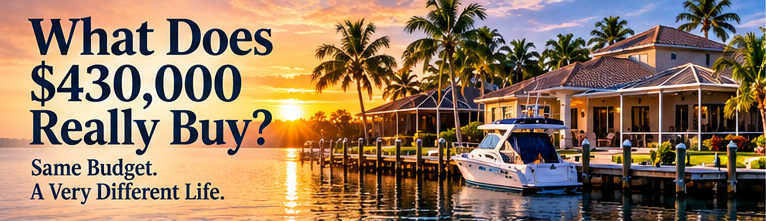
A $430,000 house costs $430,000.
That sounds simple.
But put approximately $430,000 into a home in New York, New Jersey, Pennsylvania, Illinois or Southwest Florida and the similarities can end very quickly.
The house itself may be different.
The taxes may be different.
The insurance may be different.The climate certainly is different.
And if waterfront living is part of your dream, there's an even more important distinction:
That's something a listing marked simply “waterfront” doesn't tell you.
And it can completely change what you're actually buying.
We're using approximately $430,000 because the median price of an existing home sold in
the United States in August 2026 was approximately $429,100, according to the National
Association of REALTORS®.
So this isn't a comparison of luxury estates.
It's roughly a middle-of-the-market American housing budget.
But we're adding an important rule:
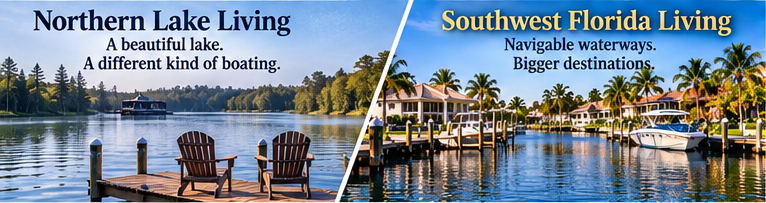
This is perhaps the most important distinction in this entire comparison.
A house on a beautiful lake in Pennsylvania can legitimately be advertised as waterfront.
So can a house on a Southwest Florida canal.
But those two properties may provide completely different boating opportunities.
Consider three broad types of waterfront:
Landlocked Waterfront
Your home may have a private dock on a beautiful lake.
You can fish.
Swim.
Kayak.
Water-ski.
Take the boat out.
But ultimately, the lake determines where the boat can go.
To cruise somewhere else, you may need to take the boat out of the water and trailer it.
Limited Connected Waterfront
Some rivers, lakes and canals connect with other navigable waterways and provide
considerably greater cruising opportunities.
That's a different proposition.
Connected Navigable Waterfront
Now we're talking about a property from which a suitable boat can potentially travel through
an extensive network of rivers, canals, coastal waterways and larger bodies of water.
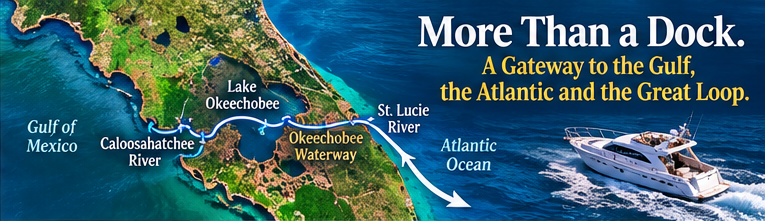
This is where Southwest Florida becomes unusual.
A suitable Gulf-access property in the Cape Coral/Fort Myers area can potentially connect a boater from a backyard dock into the Caloosahatchee River.
Travel west and you're heading toward the Gulf.
Travel east through the river and lock system and you can enter Lake Okeechobee.
Continue through the Okeechobee Waterway toward the St. Lucie system and eventually reach Florida's Atlantic side.
Think about what that means.
Your boat isn't necessarily confined to the body of water behind your house.
The water behind the house can be the beginning of a journey.
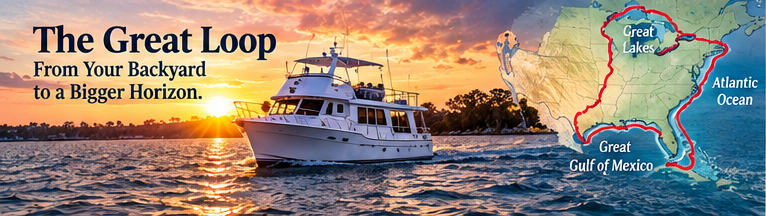
For the appropriately equipped vessel—and with careful consideration of depth, bridge
clearance, locks and other navigational restrictions—the answer can be:
A very long way.
Southwest Florida provides access into the larger network of American navigable waterways.
That includes routes used by boaters completing one of America's great cruising adventures:
The Great Loop.
The Great Loop uses connected waterways around the eastern United States and portions of
Canada, including the Atlantic Intracoastal Waterway, Great Lakes, inland river systems and
Gulf waterways.
A boater can potentially leave Southwest Florida and embark on a journey measured not in
miles around a lake...
but in thousands of miles around eastern North America.
That's a fundamentally different meaning of the word “waterfront.”
One Waterfront Home Gives You a Place to Keep Your
Boat
Another Can Give Your Boat a Route Across America
That's the distinction.
A beautiful Pennsylvania lake house may be absolutely perfect for someone who wants
freshwater lake living.
That's a legitimate—and potentially wonderful—choice.
But it isn't an equivalent boating product merely because both homes have docks.
One provides access to a lake.
The other can provide access to an interconnected system of waterways.
For someone who loves serious cruising, that's not a minor distinction.
It may be one of the most valuable features of the
property.
Can Northern States Offer Connected Waterways?
Absolutely.
And a fair comparison needs to acknowledge that.
Parts of New York have access to major connected waterways, including the Hudson River and
New York State Canal System.
New Jersey provides Atlantic coastal and Intracoastal boating opportunities.
Illinois has significant navigable-water connections through the Chicago-area waterway system
into the Illinois and Mississippi river systems—and is itself part of Great Loop routing.
So Southwest Florida doesn't have a monopoly on connected navigable water.
But now we can ask the real $430,000 question:
Can approximately $430,000 buy comparable connected navigable
waterfront...
with a dock...
in a desirable, well-served community...
close to healthcare, shopping, airports, restaurants and
entertainment...
while also providing a long or nearly year-round boating season?
That's a much tougher comparison.
And that's the comparison that actually matters.
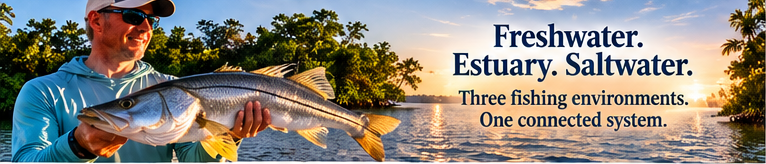
There's another fascinating characteristic of the Southwest Florida system.
The Caloosahatchee and Okeechobee system transitions through different aquatic
environments.
Lake Okeechobee and upstream portions of the system provide freshwater environments.
The lower Caloosahatchee transitions into an estuarine environment.
Continue toward the coast and you're ultimately entering saltwater.
That creates access to remarkably different fishing environments within the broader region.
Freshwater species.
This point cannot be emphasized enough.
Seeing water behind a house does not automatically mean you have access to the Gulf—or
anywhere beyond that canal system.
Some Southwest Florida canals are freshwater and landlocked.
Others provide Gulf access.
Even among Gulf-access properties, buyers must investigate:
Bridge clearance
Canal depth and width
Locks
Travel time to open water
Boat-size restrictions
Dock condition
Boat-lift capacity
Seawall condition
Tidal considerations
Flood exposure
Insurance requirements
A waterfront house can look perfect online and still be completely unsuitable for your particular
boat.
For serious boaters, this isn't a secondary consideration.
It's part of choosing the house.
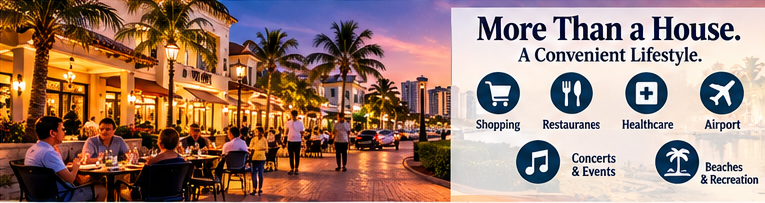
Suppose you find a $430,000 lakefront home somewhere in the North.
Beautiful house.
Private dock.
Fantastic view.
Now ask:
How far is the supermarket?
How far is the hospital?
Where are the specialists?
Where is the airport?
Where do we go for a concert?
Where's the theater?
How far is major shopping?
Where are the restaurants?
Privacy and isolation can be wonderful if that's what you're looking for.
But they're part of what you're purchasing.
By comparison, Southwest Florida's developed corridor combines residential communities and
waterfront opportunities with access to everyday services, healthcare, shopping, dining,
transportation and entertainment.
That's why location has to be part of any honest comparison.
This is where comparing homes by price alone can become misleading.
A beautiful property may look like an incredible value, but the real question is what comes with the location.
How close are everyday necessities?
Where is the nearest hospital?
Are medical specialists readily available?
If you're a veteran, how convenient is access to VA healthcare?
Where is the airport?
Where do you shop, dine, see a concert or simply go to the movies?
And if you're buying waterfront, there's another question that matters enormously:
Where can the water behind your house actually take you?
None of these considerations automatically makes Southwest Florida the right choice for everyone. A quieter or more remote community may be exactly what someone wants.
But when comparing similarly priced homes, compare more than the property.
Compare your access to life.
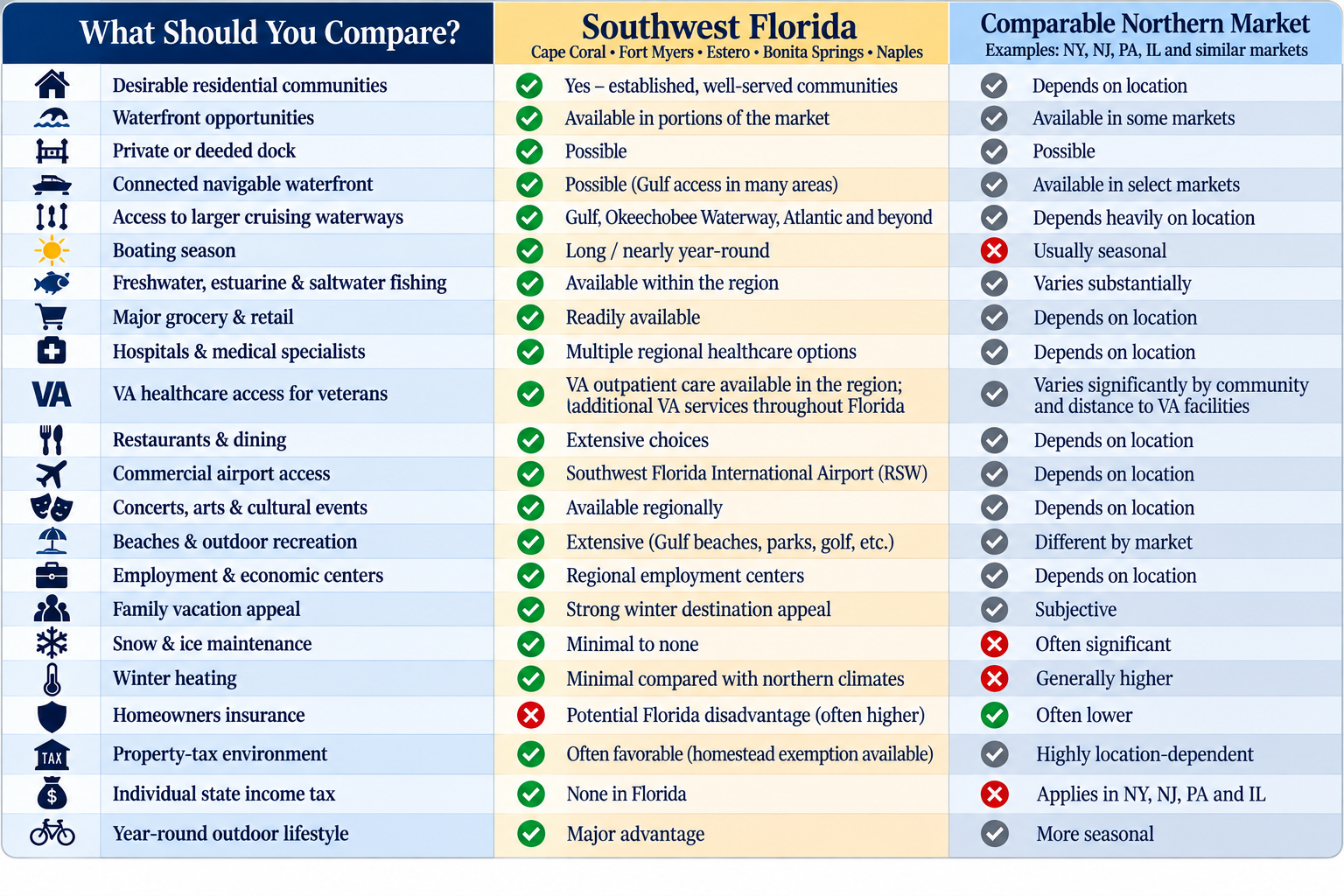
The comparisons above are general regional considerations, not guarantees for any individual property or community. Access to healthcare, VA services, shopping, transportation, waterfront, recreation and other amenities varies by specific location. Buyers should verify the services and amenities important to them before purchasing.
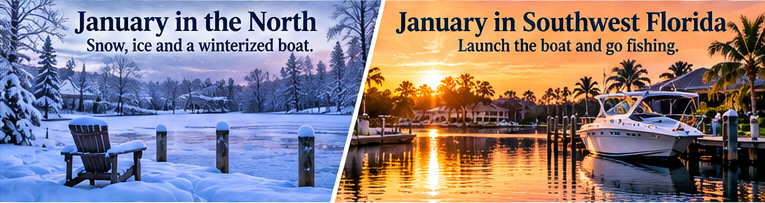
Now add climate.
Imagine two waterfront homes.
Both cost approximately $430,000.
It's January.
At the northern property, the boat may have been winterized months ago.
Snow covers the dock.
The driveway needs clearing.
Maybe you're still shoveling it yourself.
Maybe you've reached the point where you'd rather pay somebody else to do it.
Either way, winter has become part of the cost of owning the property.
Now imagine January at a suitable Southwest Florida Gulf-access property.
Make coffee.
Walk outside.
Check the weather.
Lower the boat.
Grab the fishing rods.
And go.
Same approximate purchase price.
Very different waterfront lifestyle.
Winter Isn't Free
When you're 30, clearing snow may simply be an irritating chore.
At 60, 70 or 80, you may feel differently.
And if you don't want to do it yourself, somebody has to be paid.
Winter homeownership can include:
Snow plowing
Walkway clearing
Ice removal
Deicing
Heating
Frozen-pipe prevention
Freeze-and-thaw damage
Roof and gutter stress
Pavement deterioration
Winter tires
Road-salt corrosion
Vehicle maintenance
Those costs rarely appear in a real-estate listing.
But they're part of living there.
Florida Has Costs Too
An honest comparison has to acknowledge Florida's disadvantages.
Homeowners insurance can be expensive in Southwest Florida.
Flood insurance may be appropriate or required.
Waterfront properties can present additional insurance considerations.
Homeowners may also spend more on:
Air conditioning
HVAC maintenance
Humidity control
Pest management
Pool maintenance
Landscaping
Storm preparation
Exterior maintenance from sun and moisture
There is no maintenance-free climate.
You're choosing which collection of costs comes with the lifestyle you want.
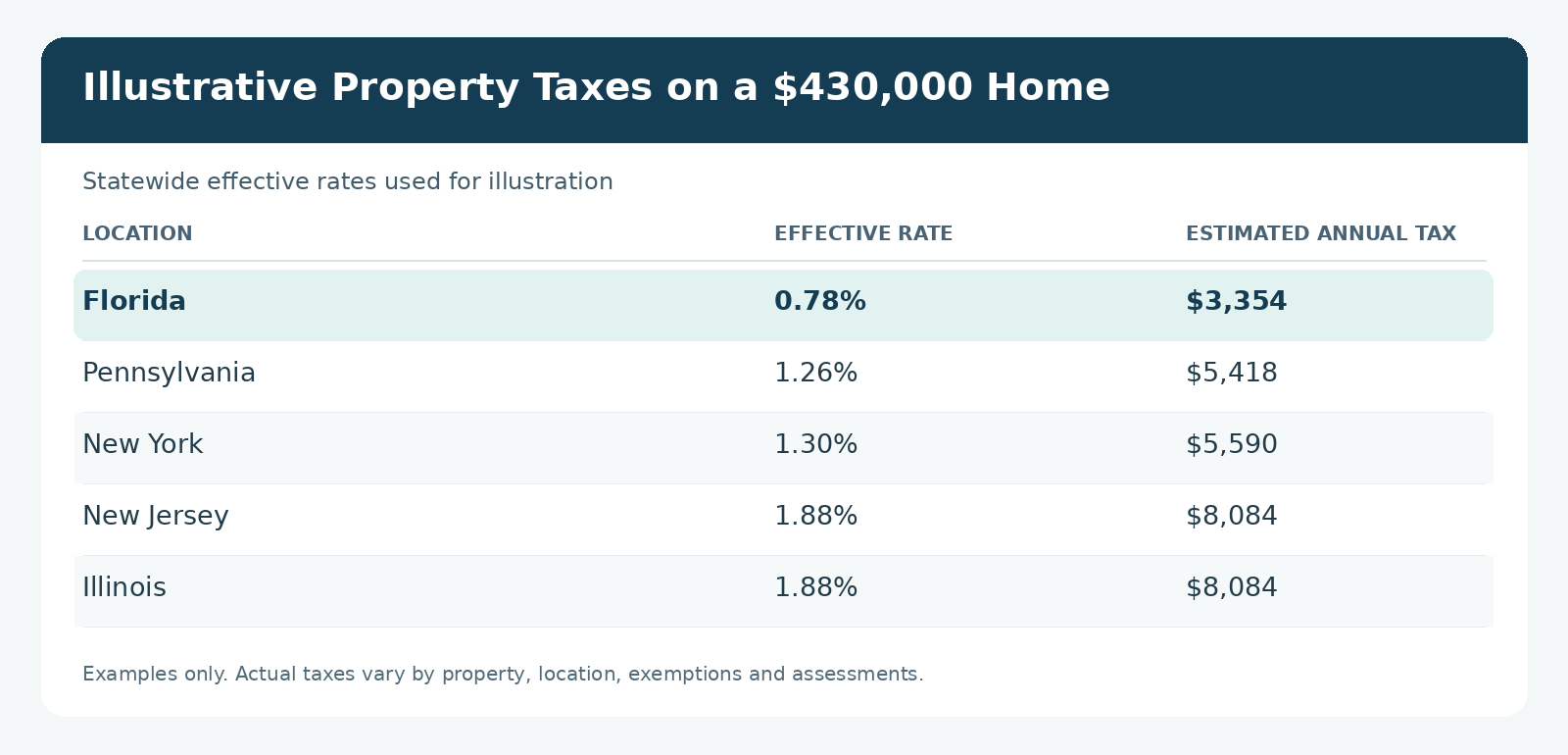
T hese figures should never be substituted for the actual tax bill on a particular property.
Local taxation varies substantially.
But they demonstrate why two homes with identical purchase prices can have very different carrying costs.
Florida also currently has no individual state income tax.
Qualifying permanent residents may benefit from Florida's homestead exemption and Save Our Homes assessment limitation.
And Florida voters are expected to consider a constitutional amendment in November 2026 that could further change certain non-school homestead property taxes.
That proposal is not guaranteed to pass and should never be treated as current savings.
Florida's long agricultural seasons allow locally and regionally grown fruits and vegetables to remain available during much more of the year.Northern states produce excellent fresh food during their growing seasons.Winter naturally limits local production.For someone interested in fresh food, farmers' markets and seasonal ingredients, climate becomes another everyday lifestyle consideration.
Warm weather doesn't automatically make anyone healthier.
But it creates opportunities.
Much of the year in Southwest Florida allows for:
Walking
Swimming
Cycling
Golf
Fishing
Boating
Gardening
Beach activities
Farmers' markets
Outdoor dining
The important word is opportunity.
The choice is still yours.
But the weather doesn't close the door for several months.
Northern winters offer activities many people love, from skiing and sledding to walks through the snow.
But as we get older, some of those activities can become harder to enjoy or may no longer suit our health and mobility.
Southwest Florida offers a different set of ways to spend time outdoors, with fewer months when cold and ice limit what we feel comfortable doing.
Sometimes it's about color.
Northern winters can be beautiful.
But after the fresh snow comes the gray snow.
Bare trees.
Dormant lawns.
Overcast skies.
Early darkness.
For months, the landscape can become shades of white, brown and gray.
Southwest Florida in January offers a different palette.
Green palms.
Blue water.
Flowers.
Sunshine.
Boats.
Beaches.
Outdoor restaurants.
People fishing.
People walking.
People playing golf.
It's not simply warmer.
Life continues outdoors.
There isn't just one way to make Southwest Florida part of your life.
There are at least three.
Option One:
Make Southwest Florida HomeLive here year-round.
Family and friends can visit.
And visiting you in January or February comes with a bonus:
A Florida vacation.
Your home can become the family's winter getaway.
Option Two: Become a Traditional Snowbird
Maintain your northern home.
Spend the warmer months near family and longtime friends.
Come to Southwest Florida for winter.
Return north when spring arrives.
For many people, that's exactly the balance they want.
Option Three: Make Florida Home—and Vacation North
This may provide the best balance for some people.
Make Southwest Florida your permanent home.
Live here nine or ten months of the year
.When summer arrives, head north for an extended visit.
See the children.
Spend time with grandchildren.
Visit friends.
Attend reunions
.Enjoy the northern lakes and countryside when they're green and alive.
Then return home to Florida.
You're not choosing between Florida and family.
You're choosing when you want to enjoy each place.
For decades, work schedules, school calendars and responsibilities determine where we're supposed to be.
Retirement can finally give us something different:
Control over our own time.
January?
Take the boat out in Southwest Florida.
February?
The grandchildren visit and escape winter.
July?
Spend a month with family up North.
August?
Travel.
September?
Come home.
Your permanent address doesn't have to determine where you spend every day of the year.
Not merely bedrooms.
Not bathrooms.
Not square footage.
It buys location.
It buys access.
It buys convenience.
It buys carrying costs.
It buys seasons.
And if you're a boater, it may buy something particularly difficult to put a price on:
Where the water behind your house can take you.
That's why the right question isn't:
“Where can I find the cheapest waterfront home?”
It's:
“Where can my budget buy the home—and the life—I actually want?”
Before comparing two similarly priced homes, ask:
What am I actually buying?
What's around the property?
How far are shopping and groceries?
How close is quality healthcare?
Where is the airport?
Where do we go for dinner, concerts or entertainment?
Is the waterfront landlocked or connected?
Where can I actually take my boat?
Can my boat clear the bridges?
Are there locks?
What's the canal depth?
How long to open water?
Can I reach the Gulf?
Can I access larger interconnected waterways?
How many months can I comfortably boat?
What are the property taxes?
What will insurance cost?
What will maintaining the house cost?
Could I live here seasonally?
Could I make this my permanent home?
Could I spend summers visiting family elsewhere?
Would my children and grandchildren enjoy coming here?
And finally:
Does this home support the life I want to live?
Because the true value of a home isn't simply what you pay to own it.
It's the life that happens there—and where that life can take you.
Whether you're considering a permanent move, a seasonal home or simply wondering what approximately the same housing budget might buy in Southwest Florida, compare more than listing prices.
Compare the property.
Compare the taxes.
Compare the insurance.
Compare the convenience.
Compare the seasons.
And if you're buying waterfront:
Compare where the water goes.
With more than 48 years of real-estate experience, Johnny Joyce can help you ask the questions that don't always appear on a listing sheet and determine whether Southwest Florida—and a particular property within it—fits the life you're planning.
Your Move. Your Season. Your Way.
This article is intended for general educational and informational purposes only and does not constitute financial, tax, legal, insurance, medical, investment, boating or navigational advice.
Property taxes, assessments, exemptions, homeowners insurance, flood insurance, utilities and maintenance expenses vary substantially by individual property and location.
Waterfront access varies dramatically. Buyers should independently verify whether a property is located on freshwater, landlocked, limited-access or Gulf-access waterways and verify canal depths, bridge clearances, locks, tides, travel times, boat-size limitations, dock and lift condition and capacity, seawall condition, flood-zone designation and insurance availability..
References to extended cruising and interconnected waterways do not mean every vessel or every Southwest Florida waterfront property is capable of accessing those routes. Vessel dimensions, draft, air draft, bridge restrictions, water depths, locks, weather, navigational conditions and other factors must be considered.
Proposed Florida constitutional amendments or legislation may be modified, rejected, challenged or otherwise fail to take effect. Current law should always be independently verified.
Individual lifestyle and health considerations vary. Nothing in this article should be interpreted as a claim that living in a particular location or climate will improve an individual's health.Prospective buyers should consult appropriate licensed real-estate, insurance, tax, financial, legal, marine and other professionals regarding their individual circumstances.